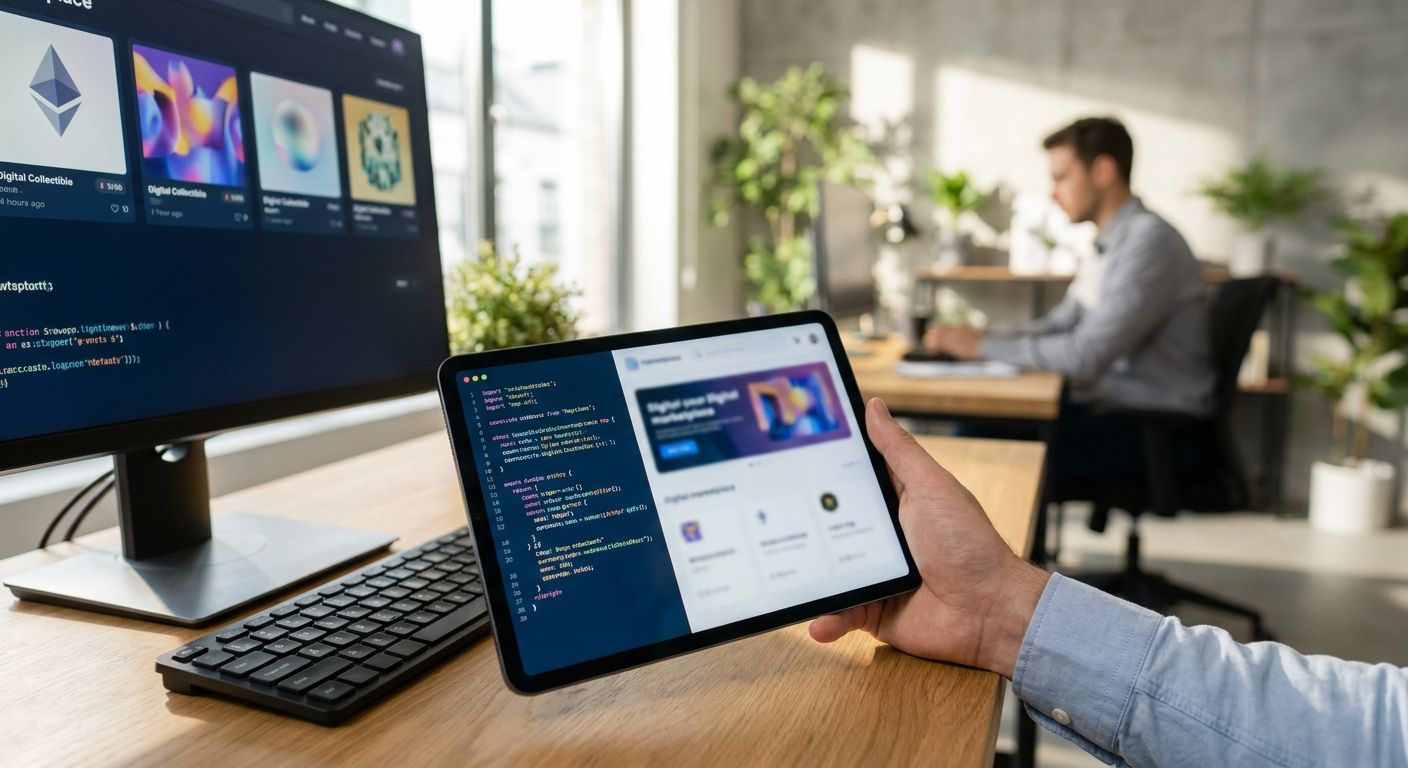
A digital collectible platform lives or dies on three things: which chains it supports, how fast creators get paid, and whether it launches before the trend window closes — an nft marketplace clone script decides two of those three before a single line of custom code gets written.
- A white-label NFT marketplace clone script beats a custom build for anyone launching before late 2026 — buy the ready template.
- Skip any clone script locked to ERC-721 only; ERC-1155 support is standard for collectible platforms now.
- Multi-chain support (Ethereum plus a low-fee chain like Polygon) matters more than theme polish for gas-sensitive collectors.
- Appkodes structures its NFT marketplace clone script around commission controls and royalty settings, not just a storefront skin.
- A from-scratch build routinely runs 6 to 12 months of smart contract development before a public sale happens.
Why this matters
NFT trading in 2026 has moved past single-chain speculation into niche digital collectible ecosystems: gaming assets, ticketing, music rights, sports moments. Buyers evaluating an nft marketplace clone script are comparing infrastructure now, not just landing-page templates.
Building that infrastructure from zero means writing and auditing smart contracts, wiring up multiple wallet SDKs, and testing auction logic before you ever list an item. A clone script exists to compress that timeline — but only if the feature set actually matches what you're selling.
Who this is for
This breakdown is for founders launching niche digital collectible platforms — gaming skins, music rights, sports moments, generative art drops — plus agencies building white-label marketplaces for multiple clients, and crypto exchanges adding an NFT vertical to an existing user base. If you're weighing this against a from-scratch build, or against a generic e-commerce theme with a wallet plugin bolted on, the differences below are where your money actually goes.
Appkodes and other vendors in this space sell the packaged version of that infrastructure. The question worth asking isn't whether a clone script is cheaper — it almost always is — it's whether the specific package includes the mechanics a collectible platform actually needs.
What to look for in an NFT marketplace clone script
Multi-chain and multi-token support
Collectors don't sit on one chain anymore. A clone script that only supports ERC-721 locks you out of semi-fungible collectible drops — game items, ticket batches, edition runs — that need ERC-1155. Check that both standards are supported natively, not bolted on as an afterthought.
Wallet integration breadth
Your buyer's wallet choice isn't your decision to make. A usable NFT marketplace clone script connects to at least three wallet providers out of the box — MetaMask, WalletConnect, and Coinbase Wallet are the baseline in 2026. Fewer than that, and you're turning away buyers before they see a listing.
Auction and sale mechanics
Fixed-price listings alone won't sustain a collectible platform. You need timed auctions, bundle sales, and ideally lazy minting so creators don't pay gas to list work that might not sell. This is the mechanic that separates a real marketplace from a storefront with NFT branding.
Royalty enforcement at the contract level
A royalty percentage that only exists as a dashboard setting isn't enforcement — it's a suggestion. Several major marketplaces made creator royalties optional starting in 2022, and that shift still shapes what buyers expect in 2026: royalties enforced at the smart contract level, not just displayed in a UI.
Admin commission and fee controls
You should be able to set and adjust your platform's commission rate without filing a developer ticket. If changing your fee structure requires a code change, the clone script wasn't built for operators — it was built for demos.
Source code ownership and customization rights
Ask this before signing anything: do you own the code outright, or are you licensing a version that stops working if the vendor relationship ends? Ownership matters the day you want to fork the platform or add a feature the original template never anticipated.
Top picks by build approach
The fast-launch pick: white-label clone script
This ships with marketplace logic already built — listing flows, wallet connections, auction contracts — so you're customizing a theme and configuration, not writing infrastructure. Appkodes packages an NFT marketplace clone script this way, aimed at teams that need to be live in days, not quarters. Buy this route if you're racing a trend window and the core feature set already covers your use case.
The deep-customization pick: source-available clone script
You get the full codebase, not a black-box contract you can't touch. This only pays off if you have blockchain developers on staff who can safely modify smart contracts without introducing security holes. Consider it if you have that team in place; skip it if you don't, because a botched contract edit is how marketplaces get exploited.
The multi-chain pick: cross-chain clone script
Built to support Ethereum plus at least one lower-fee chain like Polygon out of the box, this is the pick for platforms selling collectibles under $50, where Ethereum mainnet gas fees eat the entire margin on a sale. Buy this if your price point is low and your buyers are gas-fee-sensitive, which most digital collectible buyers are.
The niche-vertical pick: category-specific templates
Some clone scripts ship with metadata schemas built for one category — in-game item stats, music rights splits, ticket batch data. That's a real advantage if your first drop is squarely in that niche. Consider it for a focused launch; skip it if you plan to expand into general collectibles later, since a category-locked schema means rework down the line.
The from-scratch build
Writing and auditing custom smart contracts, integrating wallet SDKs one by one, and testing auction logic from nothing routinely takes 6 to 12 months before a public sale. That timeline only makes sense if you're building contract logic no existing clone script offers. For nearly everyone else, this is a skip in 2026.
If your roadmap also includes spot trading infrastructure alongside a collectibles marketplace, the same ownership and audit questions apply to that build — see the full breakdown on best crypto exchange clone scripts for startups.
Get an NFT marketplace clone script scoped
See how Appkodes structures launch-ready builds before you commit budget.
What to avoid
- Scripts marketed as "unlimited customization" with no audit report to show for it. Customization without a security audit is a liability, not a feature.
- Anything hardcoded to a single chain with no stated multi-chain path. You'll outgrow it the moment gas fees push buyers toward alternatives.
- Vendors vague about source code ownership. If the answer to "do I own this code" takes more than one sentence, assume the answer is no.
Verdict comparison
| Pick | Time to launch | Customization | Multi-chain | Verdict |
|---|---|---|---|---|
| White-label clone script | Days | Low-medium | Vendor-dependent | Buy |
| Source-available clone script | Weeks | High | Vendor-dependent | Consider |
| Cross-chain clone script | Days to weeks | Medium | Yes | Buy |
| Niche-vertical template | Days | Low (category-locked) | Vendor-dependent | Consider |
| From-scratch build | 6-12 months | Full | Custom | Skip |
FAQ
What is an NFT marketplace clone script?
An NFT marketplace clone script is pre-built software that replicates the core functions of an NFT marketplace — listings, wallet connections, auctions, and commission handling — so a founder can launch a branded platform without writing that infrastructure from scratch.
Is an NFT marketplace clone script better than building from scratch in 2026?
For most digital collectible platforms, yes: a clone script launches in days versus the 6 to 12 months a from-scratch smart contract build typically requires. Custom builds only make sense when you need contract logic no existing script offers.
Does an NFT marketplace clone script support multiple blockchains?
It depends on the script. The better options in 2026 support Ethereum plus at least one lower-fee chain like Polygon, which matters most for platforms selling collectibles under $50 where gas fees erode margins.
Do NFT marketplace clone scripts enforce creator royalties?
Only if the royalty logic is written into the smart contract itself. Since 2022, several major marketplaces made royalties optional, so check whether enforcement happens on-chain rather than as a dashboard setting that sellers can bypass.
Can I own the source code of an NFT marketplace clone script?
Some vendors sell outright ownership of the codebase, others license a version that can stop functioning if the vendor relationship ends. Confirm ownership terms before paying, since it determines whether you can fork or extend the platform later.
Which wallets should an NFT marketplace clone script support?
At minimum MetaMask, WalletConnect, and Coinbase Wallet — these three cover the majority of collectible buyers in 2026. A script missing all three will turn away buyers before they reach a listing.
Are ERC-721 and ERC-1155 both necessary in a clone script?
Yes for most digital collectible platforms. ERC-721 handles one-of-one items, while ERC-1155 handles edition runs, game items, and ticket batches — narrowing to one standard limits what you can sell.
One last thing
Royalty enforcement isn't guaranteed just because a clone script has a royalty percentage field in the admin panel. The shift toward optional on-chain royalties that started with major marketplaces in 2022 still shapes buyer expectations in 2026 — if the enforcement lives in the UI instead of the contract, any secondary marketplace can route around it and creators see nothing. Check the contract, not the dashboard.